Thoughts on How Democracies Die
March 28, 2018
Given all of the reports that have come out of the White House this past year, it's not difficult to convince yourself that American democracy is under eminent threat. But it's difficult to know whether the president's actions constitute genuine strains on America's democratic institutions, or if they are well within the realm of behavior that the government was designed to protect against. So how seriously should we be taking this?
Steven Levitsky and Daniel Ziblatt, in their latest book How Democracies Die, explain how they think about this issue. The book has been on my to-read list for a while now; I'd seen a lot of chatter about it and even listened to a few interviews with the authors, but I hadn't really had the time to sit down and read until this week.
The limitations of institutions
After the 2016 presidential election, many commentators rushed to calm the public, reminding it that the US government had specifically been designed to curtail the power of leaders with authoritarian inclinations. I, for one, was cautiously optimistic at the time—Obama's final years in office had been a demonstration of the limits of presidential authority, after all—but grew more wary as the Trump administration continued to assert power with little resistance from the legislative branch.
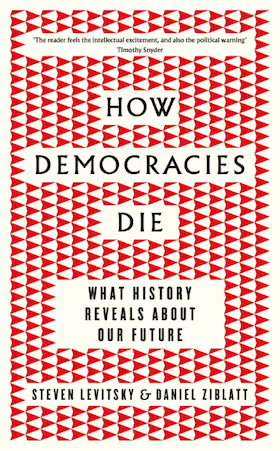
Levistky and Ziblatt argue that institutional checks are not enough—and have never been enough—to keep American democracy safe. The constitution gives institutions in the US government vastly more power than can be responsibly wielded on a regular basis. For example, there are no institutional checks keeping the president from stacking the courts with his favored nominees, or keeping Congress from rejecting every presidential nominee.
It is only because historically the members of these institutions have not used these powers except in times of crisis—what the authors call institutional forbearance—that American democracy has been more or less stable throughout its history.
It is not as though all presidents throughout history have practiced institutional forbearance. A perhaps surprising example given is that of Franklin D. Roosevelt. During 1935-36, when Roosevelt was rolling out his New Deal program, the Supreme Court blocked large portions of it, deeming them unconstitutional. In response, Roosevelt unveiled a program to expand the Supreme Court to a maximum of 13 justices, so that he could pack it with his preferred nominees. However, in this instance, Congress recognizes the importance of upholding institutional norms and blocks these measures, undeterred by Roosevelt's landslide victory in the previous election.
It's also worth noting that this was not an isolated case: the size of the court was changed seven times from 1800 to 1869. Before reading this book, I was under the impression that the documents the Founding Fathers left us were what was responsible for keeping the US a relatively well-functioning democracy, and that there were no instances of catastrophic structural failure apart from the Civil War.
This book opened my eyes to the extent to which the US government has been a continuous work-in-progress. Many of the checks and balances we take for granted today were actually added quite recently, and for much of American history it was not codified laws or documents, but rather the restraint and discipline of the people involved which kept the system from becoming derailed.
After reading Levitsky and Ziblatt's account of US history, one is left with a picture not of a country whose grand design has kept it from rescinding into autocracy, but that of an imperfect system continually steered away from collapse by its members. It is not a story of years and years of uninterrupted stability with the Civil War being its one exception; rather, it is a story of carefully managed instability.
Democratic collapse in the Post-Cold War era
Most modern democracies in the modern era have been destroyed not through violent conflict but by people who rise to power through the democratic process. This, in and of itself, is probably not surprising—Hitler's takeover of the Weimar Republic is probably the most famous instance of democratic collapse—but it is striking how well the incentives among the governing elite align to allow such a takeover once the process has begun.
History tells us that the best way to keep these rising authoritarian figures from assuming power is by having a governing elite willing to thoroughly reject this figure, even if it means endorsing a candidate they are ideologically opposed to. The authors call this mutual toleration—a willingness to accept the opposing party as legitimate and let them rule. While this may seem like an obvious rule to keep in theory, it is difficult to abide by in practice, especially given that there will undoubtedly be short-term political consequences for doing so.
Ruling elites typically believe that they can keep this rising star's power in check; however, Chávez's rise in Venezuela, Fujimoto's rise in Peru, and Hitler's rise in Germany all demonstrate how spectacularly this can fail. Prior to the inauguration, many theorized that the weight of the presidency and the bureaucracy involved in day-to-day governance would keep Donald Trump's worst habits in check, but it's probably fair to say that this isn't how things have turned out.
The seeds of Trump's rise
If we view the deterioration of institutional forbearance and mutual toleration as the root causes of the problems currently plaguing American democracy, it becomes clear that this process started before Trump started toying with the idea of a run for president. Clearly the cycle of ever-escalating partisanship had begun long before Trump had held a single stump speech.
It's difficult to know where to draw the line, but I think a good place to start looking is Newt Gingrich's time as Speaker of the House. He was the one who really started weaponizing the filibuster during the Clinton years, and although it was Mitch McConnell who really accelerated this process, Gingrich was the one who first started exploiting it. It was he who realized that if your goal is to win more seats in the next election, there never really is a reason to cooperate with the ruling party—whatever legislative accomplishments they can get work in their favor and not yours.
From a casual observer of American politics, it may seem as though the entire system suddenly went off the rails in 2016. But the US government was growing more and more dysfunctional in the decades preceding 2016, and it was just less visible because the people responsible for this dysfunction seemed reasonable if you just went by their rhetoric, and because the presidency just has much more visibility than any member of congress.
The seeds of this political crisis go back much earlier than Trump's candidacy. Simultaneously, their roots will remain even after Trump has left office. Trump's campaign would have been unthinkable at other points in history. All of which is to say: he is, in many ways, a product of our times rather than a catalyst of it.